Built for people doing difficult work together.
Adaptive Team Consulting develops practical ways to make human difference useful, complex work visible, and shared decisions more deliberate.
Give people useful structure without making them dependent on a consultant.
Adaptive Team Consulting develops and distributes How We Excel—an evidence-informed, behavior-first architecture for people who must think, lead, and adapt together when the answer is not obvious.
Its tools are designed to travel: clear enough to use without a consultant in the room, structured enough to preserve the architecture behind them, and honest about what is ready, what is being tested, and what remains to be learned.
ATC is product-first. A visitor should be able to experience something useful, decide whether it helps, and go deeper by choice—not through a sales funnel.
What ATC provides
- Structured frameworks and canvases for team and leadership work
- The publicly available CAP-5 cognitive visibility self-assessment, with validation continuing
- Audience-specific pathways: leaders, teams, partners
- An interest list for staying informed as new tools and resources are released
What ATC does not currently provide
- Routine consulting or ongoing advisory engagements
- Therapy, clinical services, or crisis support
- HR intervention, legal advice, or compliance services
- High-touch facilitation or retreats (not yet available)
Built from a lifetime of working in complex systems.
Military operations. Engineering and program management. Higher education. Research. Community fieldwork.
Across very different environments, the same question kept appearing: How do capable people with different expertise, experiences, responsibilities, and ways of thinking actually work well together when the answer is not obvious?
How We Excel grew out of that question. Dr. Therese Bensch founded Adaptive Team Consulting to turn decades of leadership, teaching, research, and field observation into tools people can use in their own work.
She holds a PhD in Public Management and Leadership, and brings more than 23 years of military service — experience that spans the full spectrum of team leadership in high-stakes, resource-constrained, and rapidly evolving environments. She has taught at the Defense Acquisition University (DAU), where her work with systems engineering and acquisition frameworks informed the development of the NavV.
Her approach to HWE is deliberately evidence-informed — grounded in established behavioral and organizational frameworks, honest about what has and has not been validated, and committed to the idea that the most useful tools are the ones people can actually use without a facilitator in the room every time.
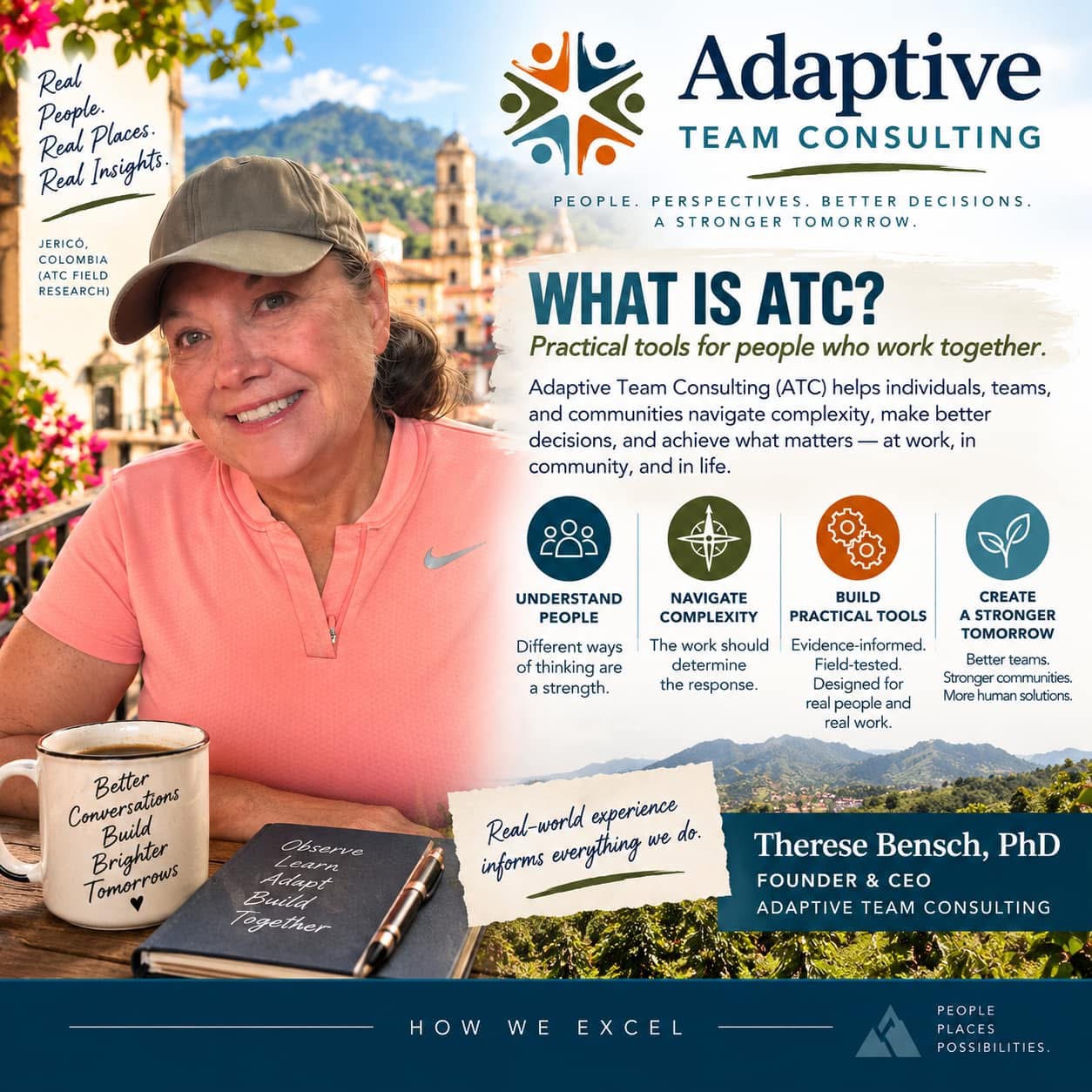
Background & Credentials
Doctoral research grounding the academic foundation of HWE
Applied team leadership across complex, high-stakes environments
Teaching systems engineering and acquisition frameworks that informed the NavV
Adaptive Team Consulting is woman veteran-owned.
The architecture under the platform
HWE is not a proprietary methodology delivered by a consultant. It is a translatable, distributable operating system — built to outlast any individual engagement.
Behavior-first
HWE is grounded in how people actually behave in shared work — not how they should behave in ideal conditions. The architecture accounts for real constraints, real cognitive variation, and real organizational dynamics.
Evidence-informed
HWE draws on established research in organizational behavior, systems engineering, cognitive science, and public management. Claims are bounded by validation status — what has been tested, what is under development, and what is theoretical.
Under active development
HWE is not a finished product. It is an architecture in ongoing validation — with tools released as they become ready, claims bounded by current evidence, and a development process that requires real-world testing, not just theoretical alignment.
Difference becomes valuable when the work is designed to use it.
These commitments shape both the How We Excel architecture and the way ATC develops public tools.
People bring different ways of knowing
Different ways of seeing, evaluating, deciding, and acting expand what a group can access. Difference creates potential; structure helps make that potential usable.
Stakeholders deserve meaningful access
The people affected by a decision need more than symbolic representation. Their knowledge, authority, evidence, and lived conditions must be reachable by the work.
Complex work becomes manageable when visible
Requirements, functions, interfaces, decisions, assumptions, and evidence can be made explicit without pretending uncertainty has disappeared.
Good solutions begin with the need
Understanding stakeholder need and required capability creates a stronger basis for choosing people, tools, structures, and solutions.
Leadership is work, not only a title
Leadership protects coherence, access, resources, evidence, handoffs, and readiness across changing phases of shared work.
Learning continues after transition
Intended use produces evidence. Sustainment, feedback, modernization, and return loops keep the solution connected to the need over time.
Read ATC’s responsible-use and claim boundaries
ATC rejects discriminatory use, overclaiming, premature solution selection, and misuse of cognitive instruments. CAP-5 and other HWE tools may not be used to rank, diagnose, exclude, or disadvantage people. Public claims remain bounded by current evidence and readiness status.
Stay with the development of this work
The interest list is the way to stay informed as new tools, resources, and frameworks become available. No routine outreach. No sales sequence. Just updates when something real is ready.